
Structured Water
What is structured water?
Structured water is water whose hydrogen bond angle — the angle formed between the two hydrogen atoms in a water molecule — has been physically widened from its ordinary value. Ordinary tap and bottled water measures about 104.5°. The John Ellis LWM-5 widens it to 113.8°–114°, and the change holds after the water cools.
“Structured water” is the term John Ellis Water uses for water in that altered state. It is a proprietary description tied to our own patented process, not a standard scientific classification. If you are comparing terminology across brands, the useful question to ask is what specific, measurable change each one is describing.
The water molecule, and what a bond angle is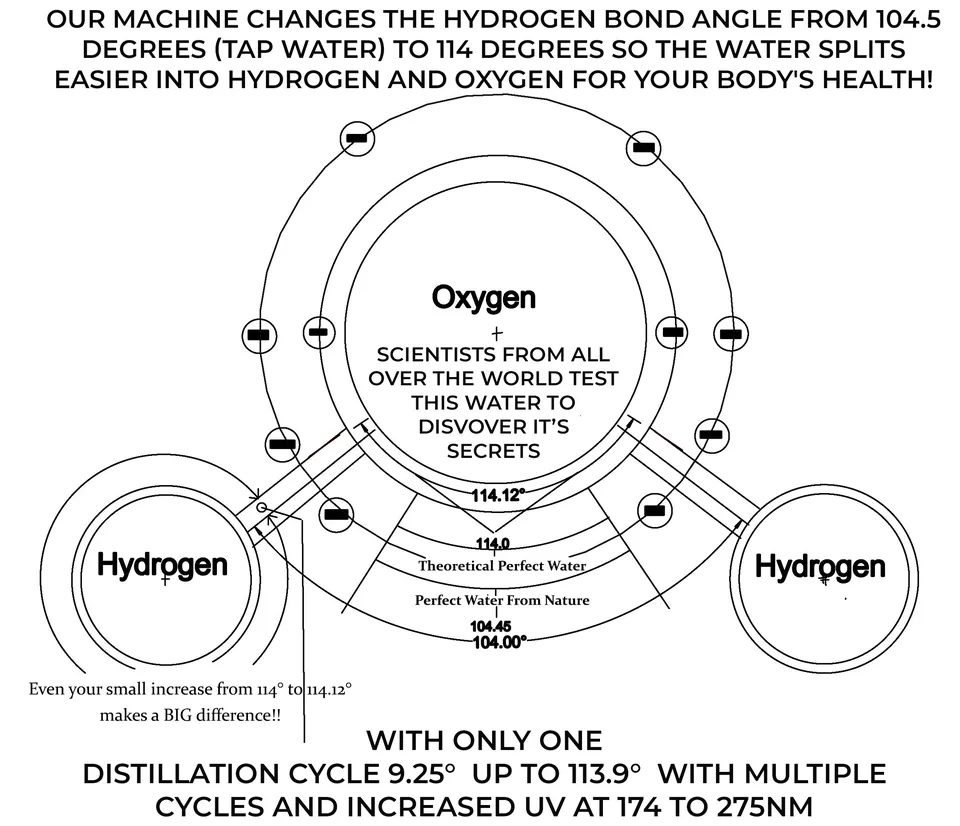
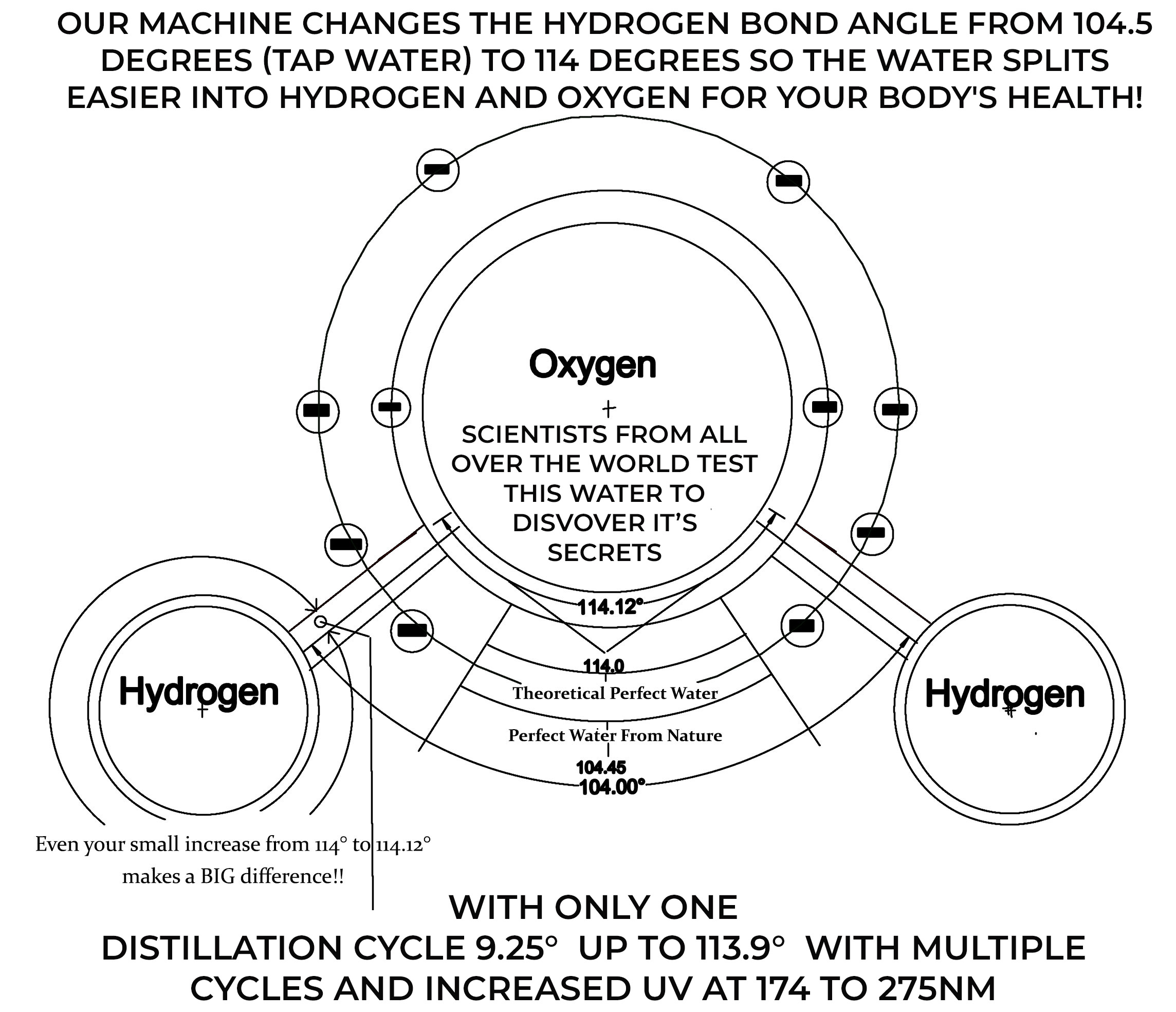
A single water molecule is two hydrogen atoms bonded to one oxygen atom — H2O. Oxygen holds the shared electrons more tightly than hydrogen does, which makes the molecule polar: the oxygen side carries a slight negative charge, the hydrogen side a slight positive one.
Because opposites attract, the positive hydrogen of one molecule is drawn to the negative oxygen of its neighbours. Those temporary connections are hydrogen bonds, and they are what give water its high surface tension and its tendency to hold itself together in droplets rather than spreading flat.
The hydrogen bond angle is the angle between the two hydrogen atoms as they attach to the oxygen. In ordinary water it sits near 104.5°. John Ellis Water has a bond angle of 113.8°. It is a physical property of the water itself and it can be measured.
How temperature changes water
Heat a water molecule and it absorbs energy, vibrates, and moves faster — stretching and breaking hydrogen bonds. Apply enough and the molecules break free of one another entirely and the liquid becomes steam.
Cooling does the reverse, and water does something unusual on the way down. Most liquids pack tighter as they cool. Water behaves normally until about 39°F (4°C); below that, hydrogen bonds force the molecules into a rigid crystalline structure that pushes them further apart. That is why ice expands, is less dense than liquid water, and floats.
This is the property the LWM-5 works with. Repeatedly driving water between those two states is what changes the bond angle.
Multi-cycle distillation: what makes it different
An ordinary distiller boils water once, in a single continuous cycle. That removes dissolved minerals and many contaminants, but the water passes through the process one time.
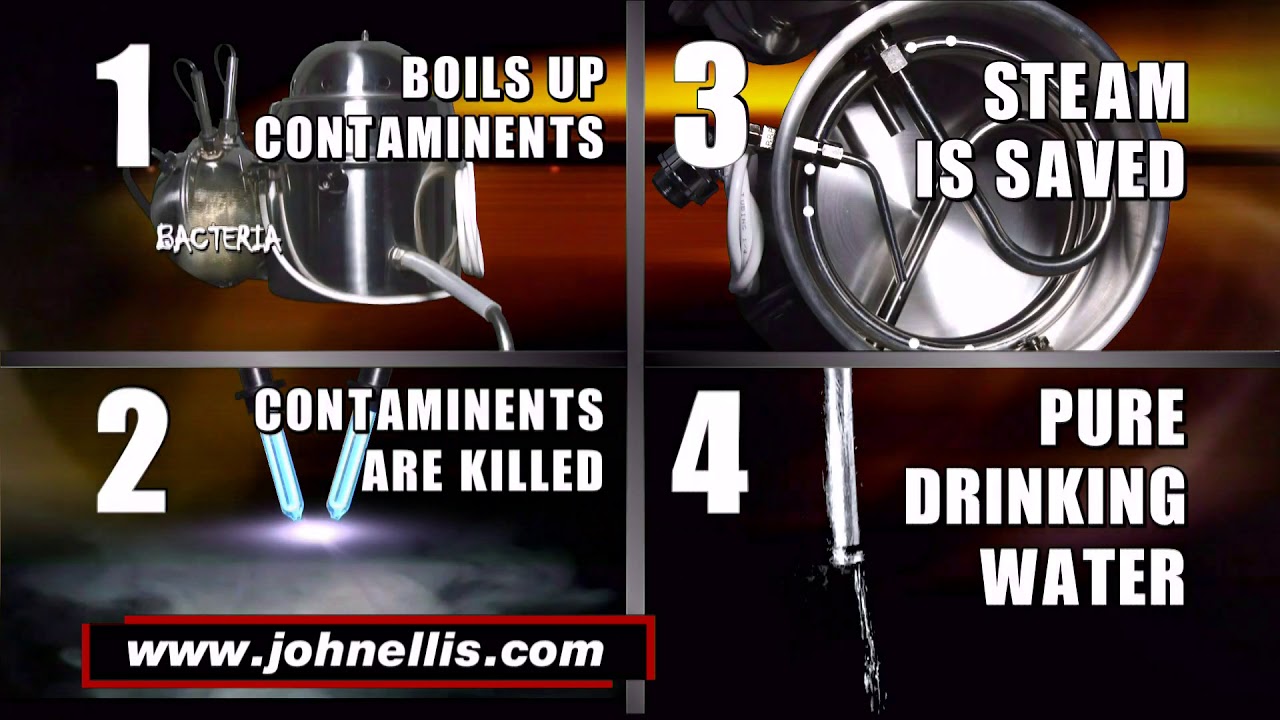
The patented John Ellis process heats and cools the water hundreds of times per gallon instead. In the LWM-5 this happens in small batches — about a cup and a half at a time, roughly three times a minute. Because a gallon takes about two hours to produce, the water passes through that heat-and-cool cycle hundreds of times before it is collected.
Why repetition rather than continuous boiling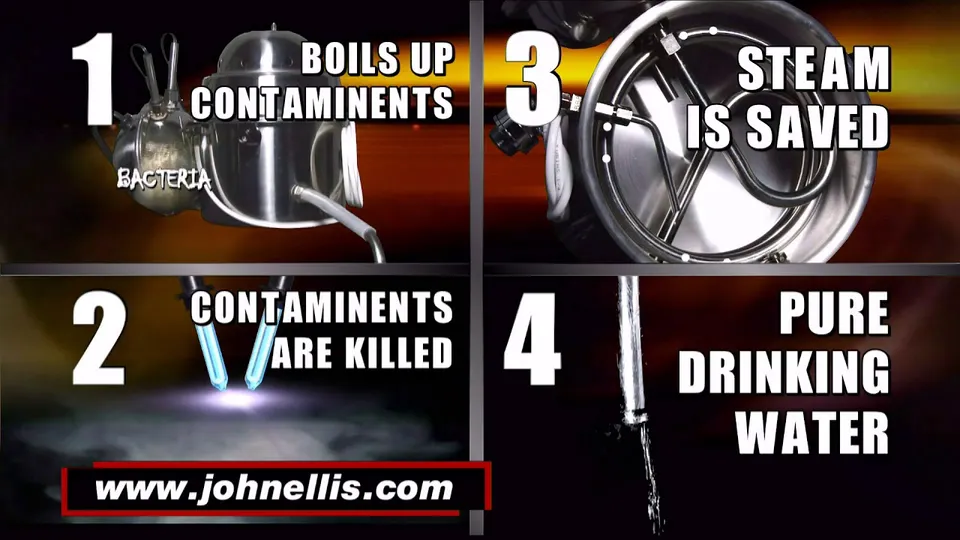
Two reasons, and the second one is the more interesting.
The first is exposure. A small volume cycled repeatedly past an ozone source gets far more contact with it than a large volume passing once.
The second is carryover. In any distiller, violent boiling can froth contaminants up and carry them over into the condensed output — trace detergents are a common example. Continuous boiling never stops, so it never stops carrying over. Stopping the boil repeatedly is what interrupts it. The U.S. Patent Office asked John Ellis to run the York Laboratory tests specifically to demonstrate that stopping the boil produces purer water; it is also the reason ordinary continuous distillers do not go below 0.1 PPM TDS.
Deuterium, and what distillation does to it
Deuterium is a naturally occurring heavier isotope of hydrogen, present in small concentrations in all water — tap, bottled, spring, and rain alike. Water made with deuterium instead of ordinary hydrogen is what is meant by “heavy water.”
Heavy water has a slightly higher boiling point than ordinary water. In a repeated heat-and-cool cycle, that difference matters: the lighter water leaves as steam first and is collected, while heavier water is left behind in the boiling chamber or flushed out through the machine’s overflow design.
That is a physical separation based on a difference in boiling point. We describe it because it is a property of how the machine works, not as a claim about what it does once consumed.
How this compares to other water treatments
The short version: a carbon filter strains water, reverse osmosis pushes it through a membrane, an alkaline ionizer changes its pH, and the LWM-5 boils and re-boils it. Those are four different things, and only the last one is trying to change the geometry of the molecule.
We have a full side-by-side breakdown of filters, reverse osmosis and distillation — including what each one removes, what it costs to run, and what needs replacing — on a page of its own: John Ellis Machine vs. Filters & Reverse Osmosis.
Two distinctions worth making here, because they cause the most confusion:
Bond angle is not pH
Alkaline ionizers alter the pH of water electrically. pH measures acidity; the bond angle describes molecular geometry. They are separate properties measured in separate ways, and a claim about one says nothing about the other. If you are comparing an ionizer to this machine, you are comparing two different things — not two grades of the same thing.
Multi-cycle distillation is not ordinary distillation
Single-pass distillation separates water from dissolved solids effectively, which is why distilled water typically tests at or near 0 PPM TDS. What it does not do is cycle the water repeatedly — and the repetition is what the John Ellis patent covers, and what the bond angle change depends on.
What we claim, and what we don’t
We report the bond angle because it is a physical property that can be measured, and the TDS figures because they come from laboratory testing. The process is covered by U.S. Patent US6409888B1 and by patents in other countries.
We do not make claims about treating, curing or preventing any medical condition, and nothing on this page should be read as one. If you have a health condition, talk to your doctor.
We also do not claim every water source behaves identically. All water is different, laboratory conditions vary, and results depend on what you start with — which is part of why the process uses two modalities, heat and ozone, rather than relying on one.
Common questions
What is TDS, and does distillation reduce it?
TDS stands for Total Dissolved Solids — the dissolved minerals, salts and metals present in a water sample, measured in parts per million. Distillation separates water from dissolved solids by converting it to steam and back, which is why distilled water typically tests at or near 0 PPM.
Does the bond angle change back when the water cools?
No. The expansion holds after cooling — the machine produces water measured at 113.8°–114° and it stays there.
Does the LWM-5 need replacement filters?
No. It is a distillation-based system rather than a cartridge-filter system, so there is nothing to replace. Periodic cleaning is recommended to prevent mineral buildup in the boiler.
How much water does it make?
About one gallon of energized-distilled water every two hours, plus up to ten gallons per hour of energized tap water from the same unit.
How much does the machine cost?
The John Ellis LWM-5 Living Water Machine is $2,800. It is hand-built in the USA from stainless steel.
See the evidence, or see the machine
The laboratory reports, the patent documents, the York Laboratory test results and the bacteria destruction reference chart are all on our Scientific Data page.
For specifications, setup instructions and the step-by-step process, see The Machine. To order, visit the LWM-5 product page or call 845-754-8696, Monday to Friday, 10am–4pm EST.
Ready to Dive Deeper Into the Science?
Unlock the full potential of your hydration by learning how advanced multi-cycle distillation recreates these optimal molecular structures.