John Ellis Machine vs. Filters & Reverse Osmosis
If you’re weighing reverse osmosis vs distillation — or comparing water filters generally — for your home, it helps to know how the three main approaches actually work before you decide.
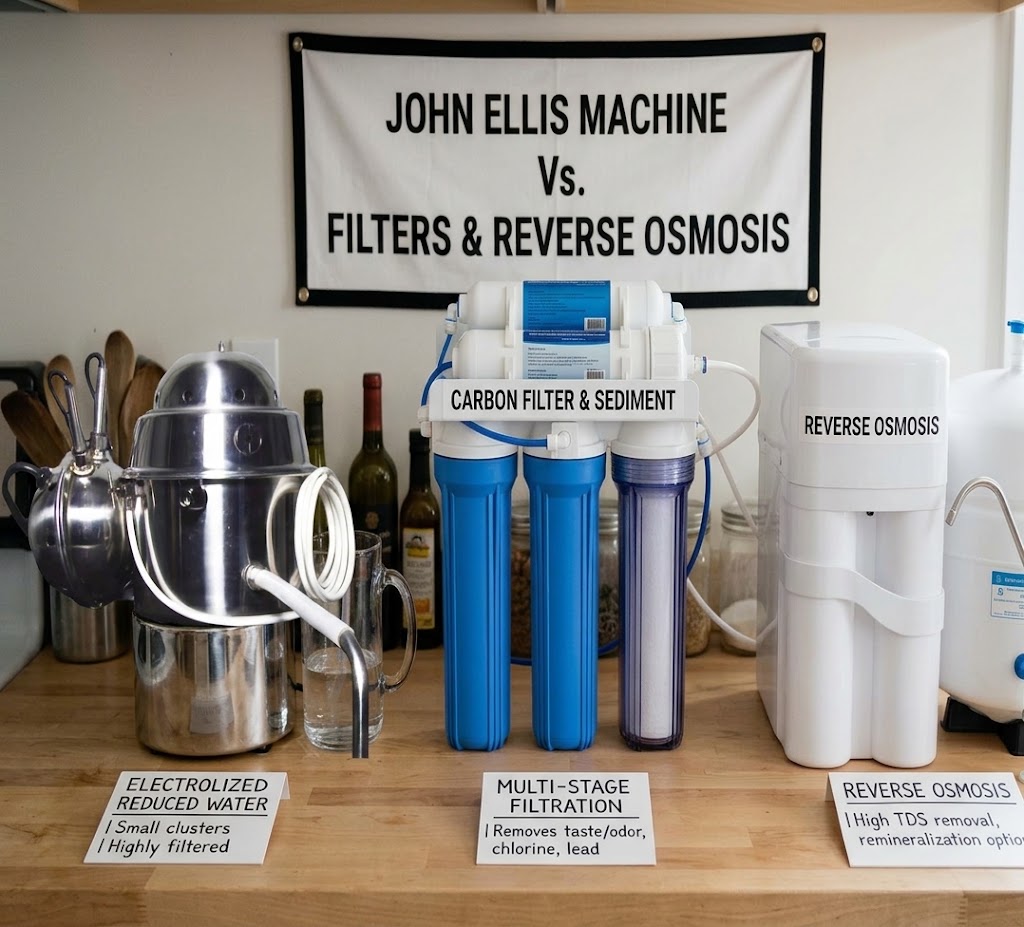
How the Three Approaches Work
Carbon Filters
Carbon filters pass water through activated carbon (opens in a new tab), which adsorbs chlorine, some organic compounds, and improves taste and odor. Most carbon filters do not significantly reduce total dissolved solids (TDS) — minerals and salts generally pass through. Filter cartridges need to be replaced on a regular schedule (often every 2-6 months) to keep working.
Reverse Osmosis (RO) vs. Distillation
RO systems force water through a semi-permeable membrane under pressure, removing a broad range of dissolved solids. This typically removes minerals along with other dissolved material, and produces reject/wastewater as part of the process (commonly several gallons of wastewater per gallon of treated water). RO membranes and pre/post filters require periodic replacement, and most residential units are installed under a sink or as a standalone unit.
The John Ellis LWM-5 (Steam Distillation + UV)
The LWM-5 uses a patented process of repeated heating and cooling cycles — recycling water hundreds of times per gallon — combined with an ultraviolet lamp in the boiler. There is no filter cartridge and no membrane: nothing to buy on a recurring schedule. The machine is a countertop unit, weighs about four pounds without the air cooler, and produces about one gallon of energized-distilled water in roughly two hours (plus up to 10 gallons/hour of energized tap water). The process is protected by 13 U.S. and foreign patents.
Side-by-Side Comparison
| Feature | Carbon Filter | Reverse Osmosis | John Ellis LWM-5 |
|---|---|---|---|
| How it works | Activated carbon adsorption | Pressure through a semi-permeable membrane | Repeated steam distillation cycles + UV |
| Recurring parts | Replacement cartridges | Membrane + pre/post filters | None — no cartridges or membranes |
| Wastewater | None | Yes, as part of the process | None |
Where the LWM-5 Is Different
- Nothing to replace on a schedule. No cartridges, no membranes — periodic cleaning is recommended to help prevent mineral buildup, but there’s no recurring part to buy.
- No wastewater. Unlike RO, the distillation process doesn’t produce a reject stream.
- Measured hydrogen bond angle. Independent testing using electrolysis has measured the LWM-5’s output at a 113.8°-114° hydrogen bond angle, versus roughly 104° for ordinary water. This is a physical, measurable property of the water itself, not a claim about how the water performs once consumed — we report it because it’s testable.
- Documented testing. The York Laboratory report has historically been cited when discussing measured purity; visit our Scientific Data page to review the original documents, testing conditions, and methodology directly.
- Family-owned, 35+ years. A real person answers the phone Monday-Friday, 10am-4pm EST, at 845-754-8696.
Frequently Asked
Does the machine require a filter change?
The John Ellis machine is not a standard carbon filter system. It uses a distillation-based process, so there are no traditional carbon filters to replace. Periodic cleaning is recommended to help prevent mineral buildup.
Is this the same as reverse osmosis?
No. Reverse osmosis vs distillation comes down to the process: RO uses a pressurized membrane and produces wastewater as part of the process, while the LWM-5 uses repeated steam-distillation heating and cooling cycles plus UV treatment, with no membrane and no wastewater stream.
Which is right for my home?
That depends on your priorities — upfront cost, recurring maintenance, install location, and portability all vary across these three approaches. The comparison above covers the mechanical differences; our full machine specifications page goes deeper on the LWM-5 specifically.
See the LWM-5 for Yourself
Read the full specifications or see pricing and order. Have questions first? Call us Monday-Friday, 10am-4pm EST, at 845-754-8696 — a real person answers.
Product information on this page describes how these water-treatment approaches work mechanically. It should not be interpreted as medical advice, disease-treatment guidance, or a substitute for professional water testing.